
Faster home construction has become a major priority as housing demand continues to place pressure on builders, developers, and property owners.
Longer timelines can raise labor costs, delay occupancy, and make projects harder to manage.
Speed matters, but quick construction should never come at the cost of safety, comfort, durability, or long-term performance.
Steel framing gives residential builders a practical way to shorten build times while supporting strength, accuracy, and consistent quality.
Compared with many traditional framing methods, steel frame systems are designed for precision, clean assembly, and efficient onsite work.
Let’s talk about those in greater detail.
Why Steel Framing Speeds Up Construction
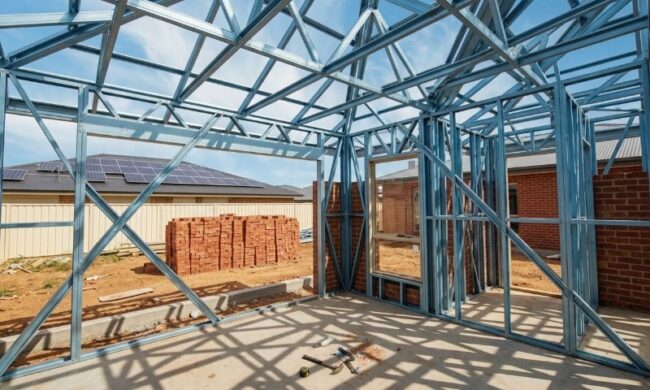
Steel framing can speed up construction because its components are much lighter than many traditional framing materials.
Lighter parts are easier to transport, lift, move around the site, and install.
Less physical effort can improve crew productivity, reduce handling delays, and support a cleaner, more organized jobsite.
Several material advantages help crews work faster during framing:
- Easier handling during unloading and placement
- Faster movement across active work areas
- Less strain during lifting and installation
- More efficient crew coordination on tight jobsites
Uniform material properties also help builders work with greater accuracy. Steel does not warp, twist, shrink, or split as wood can.
MBMA/SMDI’s steel-vs-wood document states that steel framing will not rot, warp, split, crack, or creep, and does not expand or contract with moisture content
Consistent sizing helps crews maintain tighter tolerances, reduce waste, and limit time spent correcting framing irregularities.
Better precision during framing can also make later stages, such as installing wall linings, insulation, windows, and doors, more predictable.
Large wood-framed projects may take weeks or months to frame, especially when layouts are complex or when weather delays affect progress.
When deliveries, drawings, and crews are coordinated properly, onsite assembly can benefit in several ways:
- Components arrive ready for planned installation sequences
- Labeled parts reduce confusion during assembly
- Fewer field adjustments help keep work moving
- Repeatable framing patterns help crews maintain pace
Steel’s strong strength-to-weight ratio adds another advantage. Builders can create larger spans and open floor plans without adding excessive support columns.
Keep Quality Control Tight Onsite
Onsite quality control protects the speed and precision gained during planning and prefabrication. Foundation checks should happen before frame delivery.
Levels, dimensions, anchor positions, and set-out points need review so steel components can be installed correctly.
A poor foundation can cause alignment problems that slow the entire project.
During installation, crews should inspect alignment, bracing, fasteners, and connections.
Companies such as Elythera homes use steel-frame systems to support faster assembly, durable structures, and modern residential designs.
CFSEI’s inspection guideline is specifically written as an aid for inspecting structural cold-formed steel framing under the AISI Code of Standard Practice.
Frames must be plumb, square, and properly supported.
Fasteners and bolts must be installed as specified. Connections are critical because they transfer loads through the structure.
Several checks should happen before framing work moves too far ahead:
- Foundation levels and layout dimensions
- Anchor positions and fixing points
- Frame alignment and squareness
- Bracing placement and fastening
- Bolt, screw, and connection installation
Cutting steel members, moving openings, or altering connection points without engineering approval can weaken the frame or create compliance issues.
Changes should be reviewed by qualified professionals before work continues.
Inspections should be completed before walls and ceilings are closed. Once linings are installed, hidden problems become harder and more expensive to fix.
Before a close-up, installers should confirm important hidden work:
- Frame alignment
- Structural bracing
- Service penetrations
- Insulation placement
- Joint sealing
- Window and door flashing
- Fastener and connection quality
Use Prefabrication and Planning to Maintain Quality
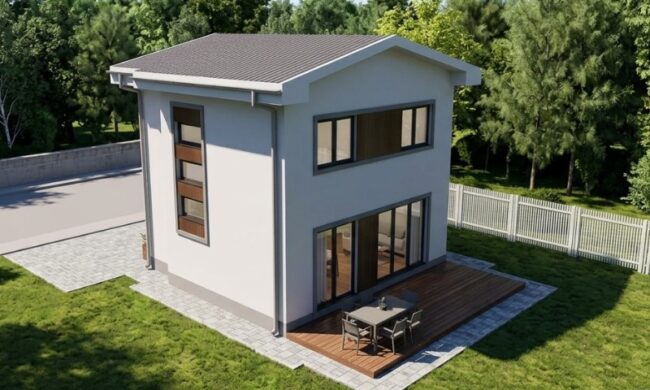
Strong steel frame construction begins before materials arrive on-site.
Design, engineering, openings, load paths, and service routes should be finalized before fabrication starts.
Plumbing, electrical, HVAC, window positions, door openings, and structural connections all need proper coordination early in the project.
Key items should be settled before fabrication begins:
- Final frame dimensions and structural drawings
- Window and door opening locations
- Plumbing, electrical, and HVAC routes
- Bracing, fastening, and connection details
- Delivery sequence and installation plan
Late changes can slow work, increase costs, and raise the risk of errors.
Factory-made steel components can improve accuracy because they are produced using exact dimensions in controlled conditions.
Pre-engineered elements can be cut, punched, labeled, and organized before delivery.
ClarkDietrich’s cold-formed steel design guide describes pre-punched C-studs designed for the rapid installation of pipes, electrical conduit, and wall bridging.
Accurate factory production helps reduce onsite measuring, cutting, and adjustment work. Less improvisation on-site usually means fewer mistakes.
Labeled components also make assembly easier. Crews can match parts to plans, follow a clear sequence, and install sections with greater confidence.
Prefabricated wall frames, roof framing, floor systems, and other sections can be bolted or fastened together on-site.
AWCI’s cold-formed steel framing primer says current fabrication techniques allow contractors to prefabricate panels in a shop under controlled conditions, so framing panels can begin erection immediately once slabs are complete.
Protect Energy Efficiency
@cyrusdegreat1 Same square footage. Very different results. A steel-framed home can save you up to $2,400 a year in energy costs 💡That’s the kind of long-term payoff you get when the build is done right from start to finish. 🤝 To learn more, click the link in the bio or visit www.netzehomes.com #NetzeHomes #SteelFramedHomes #EnergyEfficientLiving #ModernDesign #EcoFriendlyHomes #BuiltToLast #SmartConstruction #DFWRealEstate
Energy efficiency needs special attention in steel-frame homes because steel conducts heat much faster than wood.
Heat can move through steel studs, roof framing, and floor framing, creating thermal bridges.
In cold climates, thermal bridging can increase heat loss. In warm climates, it can increase heat gain. Poor detailing can reduce comfort and raise energy costs.
Thermal bridging can also lower the effective performance of insulation in walls, roofs, and floors.
Insulation placed only between steel framing members may not perform as expected if heat travels through the steel itself.
Continuous exterior insulation can help reduce that problem by creating a more complete thermal break around the structure.
Effective thermal detailing usually includes several connected measures:
- Continuous exterior insulation to reduce heat transfer through steel
- Insulation in wall, roof, and floor assemblies
- Careful sealing around joints and penetrations
- Window and door installation that limits air leakage
- Detailing that allows for temperature movement without gaps
Good insulation choices include spray foam, rigid foam boards, and fiberglass.
Wall cavities, roof assemblies, and floors should be insulated with attention to thermal performance, moisture control, and code requirements.
FAQs
Summary
Steel framing can help homes go up faster, but speed must be supported by careful planning and strict quality checks.
Faster construction is only valuable when the finished home is strong, efficient, comfortable, and durable.
Best results come by combining prefabricated steel systems, energy-smart detailing, and disciplined onsite workmanship.
Regular inspections help confirm that the frame, connections, bracing, and building envelope meet the required standard.