
High RTP online slots remain one of the most searched casino topics in 2026 because players want clearer numbers before they choose a game. That is reasonable. A slot with a stronger theoretical return can be a better starting point than a game with poor published data.
Still, RTP is not a promise. It does not tell you what will happen tonight, this week, or during your next 100 spins. The value appears over huge samples, often millions of rounds. This article reviews how online slots with better return rates work, what makes them attractive, and where their limits begin.
Why RTP Still Matters For Slot Players In 2026

RTP in online slots means the expected long-term return built into the game math. If a slot has a 96 percent RTP, the model suggests that, over a very large number of spins, it returns 96 units for every 100 units wagered. The remaining four units represent the theoretical house edge.
The return to player percentage helps players compare games before risking money. It is not perfect, but it is more useful than judging a slot by its theme, soundtrack, or bonus animation. A jungle slot with 94 percent RTP and a space slot with 97 percent RTP may look equally polished. Mathematically, they are not equal.
In 2026, many studios publish RTP ranges rather than one fixed number. This matters because the same title may run at different settings across operators. A game listed at 96.5 percent on the provider site could appear at a lower setting elsewhere. That makes checking the in-game information screen more important than trusting a generic review.
How High RTP Slots Differ From Regular Slots
The highest RTP slot games are usually not magic products with special winning behavior. They are games with math models that return a slightly larger share of total wagers over time. The difference may look small, but it compounds across repeated play.
For example, a 97 percent slot has a theoretical house edge of 3 percent. A 94 percent slot has a theoretical house edge of 6 percent. The second game is twice as expensive in theoretical terms. That does not mean the first game will pay more in every session. It means its long-term structure is less costly.
Fair digital slots use a random number generator to determine outcomes. The RNG does not remember your last spin. It does not become “due” after a dry run. Testing labs and certification bodies can verify whether the software behaves according to the approved math model, but they cannot remove variance from the game.
This is the first major trade-off. Better RTP improves the theoretical terms. It does not give control over timing.
RTP Is Not The Whole Story
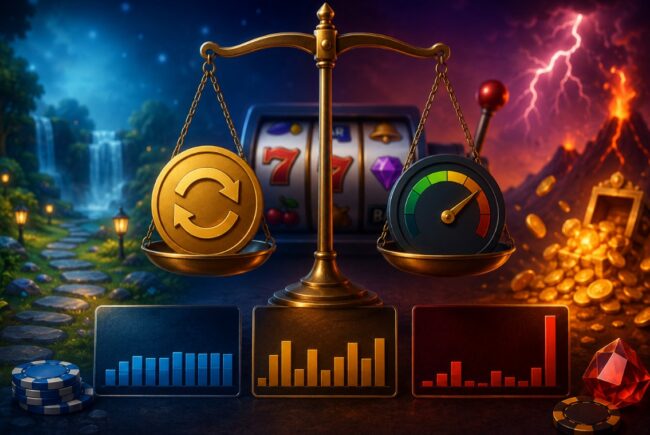
RTP tells you how much a game is designed to return. Slot volatility tells you how that return may be distributed. A high RTP game can still feel brutal if wins are rare and bonus rounds are hard to trigger.
Low volatility slots usually pay smaller amounts more often. They can suit players who prefer longer sessions and steadier feedback. High-volatility games may offer larger wins, but they often require more patience and a larger budget. Medium-volatility titles sit between those styles.
This is why a 97 percent slot is not automatically better for every player. Someone with a small session budget may have a poor experience on a high-volatility game, even when the RTP looks strong. A less volatile title with a slightly lower RTP may provide more playing time.
The “best” choice depends on your goal. If you want a longer session, volatility may matter as much as RTP. If you chase rare bonus features, you must accept longer losing streaks.
What To Check Before Choosing A High RTP Slot
Choosing the best RTP slots 2026 is less about chasing one headline number and more about checking the full game environment. Before playing, review these points carefully:
- Confirm the RTP inside the game menu, not only on a review page.
- Check whether the game uses fixed RTP or adjustable RTP settings.
- Review the volatility rating and match it to your session budget.
- Look at the reputation of casino game providers and their testing history.
- Read bonus wagering requirements before using free spins or matched offers.
- Test the demo version first if it is available in your region.
- Check maximum bet rules if you plan to play with a bonus balance.
This short review can prevent common mistakes. Many players lose value by accepting a bonus without reading the terms. Others pick a famous slot name and never check whether the RTP version is lower than expected.
Where Players Usually Find Better Return Rates
Players usually find stronger game data on platforms that publish clear information. The best sites make RTP visible in the game help file, list provider names, and explain bonus rules in plain language. They also support deposit limits and session controls.
Local availability matters too. A slot may be visible in one country but restricted in another. Payment methods, identity checks, and game libraries can also change by region. Players comparing platforms in South Asia may review options such as LEONBet India while checking whether specific titles, limits, and promotional terms match their needs.
Licensed online casinos are also more likely to work with audited studios and structured compliance rules. Licensing alone does not make gambling safe. It does, however, create a clearer framework for dispute handling, game approval, and player verification.
Good platform selection also supports bankroll management. A clear cashier page, realistic minimum bets, and easy limit tools help players keep sessions controlled. These features may sound boring, but they often matter more than a flashy welcome banner.
The Strong Counterargument: High RTP Can Still Lose Fast

The strongest argument against focusing on RTP is simple. You can choose a high-return slot and still lose your deposit quickly. This is not a contradiction. It is how variance works.
A slot’s long-term return does not smooth out short-term results. Ten spins can all miss. A bonus round can pay less than the triggering bet. A game with a strong theoretical model can still produce a cold session.
This matters because some players treat RTP like protection. It is not. A high RTP reduces theoretical cost, but it does not remove risk. If your stake is too large compared with your budget, even a good game can become expensive very quickly.
The practical answer is to reduce spin size, set a time limit, and avoid chasing losses. These habits do not increase RTP. They reduce the chance that one bad session becomes a bigger financial problem.
FAQ
The questions below address the most common misunderstandings about RTP, variance, bonuses, and game choice in 2026.