
An accident scene doesn’t stay preserved for long. Skid marks fade or get washed away. Damaged vehicles get towed. Witnesses head home and go back to their normal routines. Within hours, traffic resumes as if nothing happened there at all.
That rapid disappearance creates a real problem for anyone trying to piece together what actually occurred later on. Without something documenting the scene while it’s still fresh, important details can be lost entirely, replaced only by fading memory and assumption.
That’s exactly the gap an Austin car accident report helps fill, preserving key details recorded around the time of the collision, long after the physical evidence at the scene has already disappeared from the roadway itself.
What Actually Makes It Into the Report
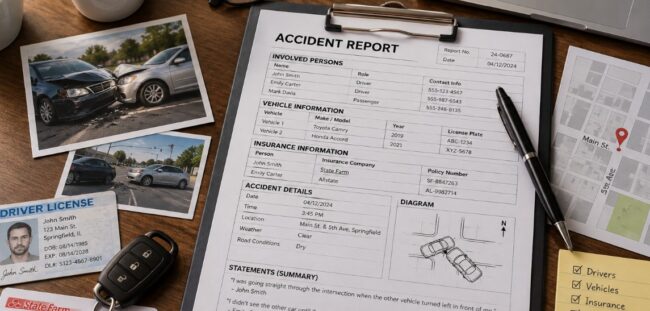
A typical accident report includes a range of important information, starting with identifying details for everyone involved, including drivers, passengers, and vehicles present at the scene when the responding officer arrived to investigate.
Insurance information usually gets documented too, along with the specific location of the collision and diagrams illustrating how the vehicles were positioned. Statements from those involved often appear as well, along with any citations issued in connection with the incident.
Together, these details create a reasonably comprehensive snapshot of the scene and circumstances surrounding the collision. That documentation becomes considerably more valuable over time, once memories fade and the physical scene itself no longer exists in its original condition.
Small Details Can Become Important Later
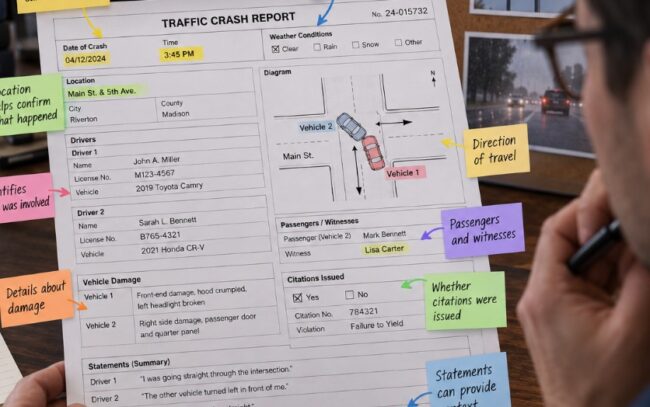
Some information in a crash report may seem almost insignificant when it is first read. A street name, vehicle direction, weather condition, time entry, diagram marking, or description of visible damage might initially feel secondary compared with the collision itself.
Later, those details can become much more important.
For example, a report may help establish:
- the exact location and approximate time of the collision;
- which vehicles and drivers were identified at the scene;
- the direction vehicles were traveling before impact;
- whether passengers or witnesses were documented;
- what damage the officer recorded;
- whether citations were issued; and
- what statements were provided shortly after the incident.
None of those details necessarily answers every question about responsibility on its own. Their value comes from preserving information that might otherwise become difficult to reconstruct accurately.
That is why reviewing the entire report can matter more than simply looking for a sentence saying who caused the crash. Often, the useful information is distributed across several sections rather than contained in one obvious conclusion.
The Report Isn’t a Video Replay
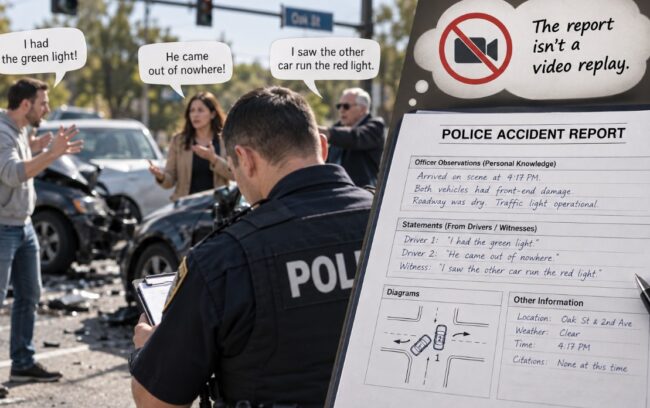
Despite how comprehensive it might seem, an accident report has real limitations worth understanding. It’s not an objective recording of every single detail. Much of the content reflects what the officer directly observed, combined with information other parties provided afterward.
That distinction matters considerably. Information the officer witnessed firsthand carries different weight than statements collected from drivers or witnesses, which may reflect incomplete memory, differing perspectives, or simple human error rather than objective, verified fact about what actually happened.
Understanding this limitation helps set realistic expectations. The report offers a valuable starting point for understanding a collision, but it isn’t necessarily a complete or entirely objective account of every single detail surrounding the incident itself.
Why People Need the Report Later
Accident reports serve several practical purposes well beyond the day of the collision itself. Insurance companies frequently require them when processing claims, using the documented details to help evaluate what happened and how responsibility might be allocated between parties.
Legal matters often depend on this documentation too, particularly when questions about fault or the sequence of events become disputed later. Vehicle repair processes sometimes require the report as well, especially when insurance coverage depends on official documentation of the incident.
Beyond these practical uses, the report also helps reconstruct basic facts that might otherwise be forgotten entirely. Names, dates, and other key details become considerably harder to recall accurately as time passes following the original collision.
How to Get a Copy in Austin

Obtaining a copy of an accident report in Austin generally involves specific request procedures, often available through official channels designed for exactly this purpose. Requesting parties typically need certain identifying information related to the collision itself.
Processing times and any associated fees can vary, so confirming current procedures directly with the relevant department helps avoid confusion or unnecessary delay. Requirements can shift over time, making it worthwhile to verify current steps rather than relying on outdated information.
Taking the time to properly request this documentation matters, since the report often becomes an important reference point later, particularly if insurance or legal questions arise well after the collision itself has already faded from immediate memory.
Frequently Asked Questions
1. How soon after an accident can a crash report become available?
Texas law requires an officer who investigates a qualifying crash to submit the written report to TxDOT no later than the tenth day after the crash. That does not necessarily mean the report will appear in an online search immediately, since it still has to be received and processed.
2. Can anyone obtain a full Texas crash report?
Not necessarily. Texas crash reports contain confidential information, and state law identifies specific people and organizations that may obtain an unredacted copy, including people involved in the crash, vehicle owners, certain representatives, and insurers. Someone who does not meet the applicable criteria may instead receive a redacted version.
3. What is the difference between a regular and certified crash report?
TxDOT currently charges $6 for a regular crash report and $8 for a certified copy, before any applicable transaction fees. A certified copy is generally requested when an official version of the document is needed, such as for a legal proceeding.
4. How long does TxDOT keep crash reports?
TxDOT’s current retention schedule covers the previous 10 full calendar years plus the current year. Reports or detailed crash data outside that period may therefore no longer be available through the normal records system, although some historical annual statistics can remain available separately.
Conclusion
An accident report might look like an ordinary piece of paperwork, but it often becomes one of the few lasting records of an event that physically disappeared from the roadway within hours, sometimes minutes, of actually occurring.
That documentation matters considerably more than its plain appearance suggests, preserving details that would otherwise rely entirely on fading memory. Understanding both its value and its limitations helps anyone navigating the aftermath of a collision use it appropriately.
Requesting and reviewing that report often becomes an important early step, providing a documented foundation for whatever comes next, whether that involves insurance claims, repairs, or other matters connected to the collision.