
Marriage is one of the most important legal and personal commitments that an individual can make. While many marriages are successful and long-lasting, some relationships unfortunately reach a point where reconciliation is no longer possible. In such situations, divorce may become the most practical solution for both parties.
In Malaysia, divorce procedure in Malaysia is governed by different laws depending on whether the parties are Muslims or non-Muslims. The legal process can be complex, involving documentation, court procedures, division of assets, child custody arrangements, and maintenance claims. As a result, many individuals seek the assistance of a divorce lawyer in Malaysia to guide them through the process and protect their legal rights.
Understanding the role of a divorce lawyer and the divorce procedure in Malaysia can help individuals make informed decisions and prepare themselves for the legal journey ahead.
The Role of a Divorce Lawyer in Malaysia

A divorce lawyer in Malaysia is a legal professional who advises and represents clients in matters in Malaysia relating to the dissolution of marriage. Lawyers assist clients in understanding their rights, obligations, and available legal remedies throughout the process.
Legal Advice and Consultation
One of the primary roles of a divorce lawyer is to provide legal advice. During the initial consultation, the lawyer will review the circumstances of the marriage, discuss the reasons for seeking a divorce, and explain the available legal options.
The lawyer may also advise on matters such as:
- Child custody
- Child maintenance
- Spousal maintenance
- Division of matrimonial assets
- Domestic violence issues
- Financial settlements
Obtaining legal advice at an early stage often helps clients avoid costly mistakes and unnecessary disputes.
Preparation of Legal Documents

Divorce proceedings require numerous legal documents to be prepared and filed correctly. A lawyer ensures that all documents comply with legal requirements and court procedures.
These documents may include:
- Divorce petitions
- Joint petitions
- Affidavits
- Custody applications
- Maintenance applications
- Consent orders
- Financial disclosure documents
Errors in documentation may result in delays or complications, making professional assistance highly beneficial.
Negotiation and Settlement
Many cases can be resolved through negotiation rather than lengthy court battles. Lawyers often negotiate with the opposing party or their lawyer to reach agreements on:
- Custody arrangements
- Visitation rights
- Division of property
- Maintenance payments
An amicable settlement can save time, legal costs, and emotional stress for both parties.
Court Representation
If disputes cannot be resolved through negotiation, the matter may proceed to court. In such cases, a divorce lawyer represents the client throughout the legal proceedings.
The lawyer will:
- Present evidence
- Examine witnesses
- Make legal submissions
- Protect the client’s interests
- Advocate for fair outcomes
Professional representation is particularly important when significant assets or child custody issues are involved.
Types of Divorce in Malaysia for Non-Muslims
For non-Muslim marriages registered under Malaysian law, there are generally two main categories of divorce.
Joint Petition Divorce
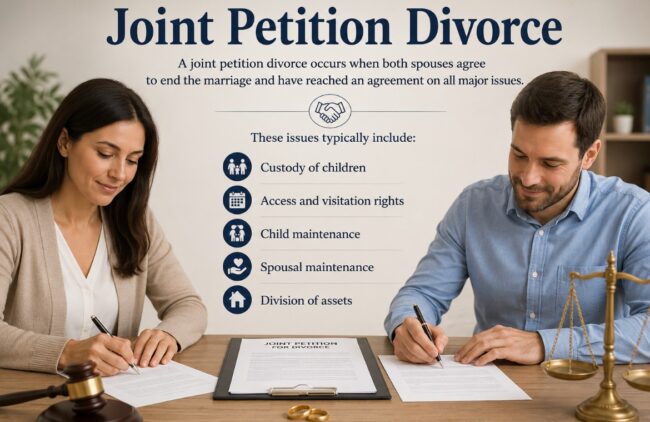
A joint petition divorce occurs when both spouses agree to end the marriage and have reached an agreement on all major issues.
These issues typically include:
- Custody of children
- Access and visitation rights
- Child maintenance
- Spousal maintenance
- Division of assets
Since both parties agree to the terms, the process is generally faster and less expensive than a contested divorce.
Single Petition Divorce
A single petition divorce is filed by one spouse when the other spouse does not agree to the divorce or when disagreements exist regarding important matters.
In such cases, the court may need to determine:
- Whether the marriage has irretrievably broken down
- Child custody arrangements
- Maintenance obligations
- Division of matrimonial assets
Contested divorces usually involve longer proceedings and higher legal costs.
Legal Grounds for Divorce

For non-Muslims, the court generally grants a divorce when the marriage has irretrievably broken down.
Several circumstances may demonstrate an irretrievable breakdown of marriage.
Adultery
If one spouse has committed adultery and the other spouse finds it intolerable to continue living together, this may form the basis of a divorce petition.
Unreasonable Behaviour
A spouse may seek a divorce if the other spouse behaves in a manner that makes it unreasonable to continue living together.
Examples may include:
- Emotional abuse
- Physical abuse
- Gambling addiction
- Substance abuse
- Serious neglect of family responsibilities
Desertion
Desertion occurs when one spouse abandons the other without reasonable cause for a significant period.
Separation
Where spouses have lived apart for a substantial period, separation may support a divorce application depending on the circumstances and applicable legal requirements.
Divorce Procedure in Malaysia
Understanding the divorce procedure can help individuals prepare for the process and reduce uncertainty.
Step 1: Consultation with a Lawyer
The first step is usually to consult a lawyer.
During this consultation, the lawyer will:
- Assess the facts of the case
- Review marriage documents
- Discuss available options
- Estimate legal costs
- Explain likely timelines
Clients should provide complete and accurate information to enable proper legal advice.
Step 2: Gathering Relevant Documents
The lawyer will generally request supporting documents such as:
- Marriage certificate
- Identification documents
- Birth certificates of children
- Financial records
- Property ownership documents
- Bank statements
These documents assist in preparing the necessary court papers.
Step 3: Filing the Divorce Petition
Once the required information has been collected, the lawyer prepares and files the divorce petition.
For a joint petition, both spouses sign the necessary documents.
For a single petition, one spouse files the petition and serves it on the other spouse.
Step 4: Court Proceedings
The court will schedule a hearing after the documents have been filed.
For uncontested cases, the hearing is usually straightforward. The court reviews the documents and ensures that the arrangements are fair and lawful.
For contested cases, multiple hearings may be required to resolve disputed issues.
Step 5: Divorce Order
If the court is satisfied that the legal requirements have been met, it will grant the divorce.
The court may also issue orders concerning:
- Child custody
- Maintenance
- Property division
- Visitation rights
Once the divorce order becomes effective, the marriage is legally dissolved.
Child Custody in Divorce Cases

Child custody is often one of the most sensitive aspects of divorce proceedings.
The court’s primary consideration is the welfare and best interests of the child.
Types of Custody
Custody arrangements may include:
Legal Custody
Legal custody refers to the authority to make important decisions regarding the child’s welfare, education, healthcare, and upbringing.
Physical Custody
Physical custody concerns where the child primarily resides.
Joint Custody
In some situations, parents may share responsibilities and decision-making authority.
Factors Considered by the Court
The court may consider factors such as:
- Child’s welfare
- Child’s age
- Emotional needs
- Educational requirements
- Stability of the home environment
- Relationship between parent and child
The court seeks arrangements that promote the child’s overall well-being.
Child Maintenance
Parents have a legal responsibility to support their children financially.
Maintenance may cover:
- Food
- Clothing
- Housing
- Education
- Medical expenses
- Daily living expenses
The amount of maintenance depends on factors such as:
- Income of the parents
- Financial needs of the child
- Standard of living
- Educational expenses
Failure to comply with maintenance orders may result in legal enforcement action.
Spousal Maintenance
In certain circumstances, one spouse may be required to provide financial support to the other after divorce.
The court considers factors such as:
- Financial resources
- Earning capacity
- Age and health
- Duration of marriage
- Standard of living during marriage
The objective is to achieve fairness and financial stability where appropriate.
Division of Matrimonial Assets
The division of assets is often one of the most significant financial issues arising from divorce.
Matrimonial assets may include:
- Family homes
- Vehicles
- Investments
- Savings
- Businesses
- Retirement funds
Factors Considered by the Court
The court may consider:
- Financial contributions
- Non-financial contributions
- Care of children
- Duration of marriage
- Needs of each spouse
Non-financial contributions such as homemaking and childcare may also be recognised when determining a fair distribution of assets.
Benefits of Hiring a Divorce Lawyer in Malaysia

Although individuals may attempt to handle divorce matters themselves, engaging a divorce lawyer offers several advantages.
Legal Expertise
Divorce lawyers understand family law and court procedures, reducing the risk of procedural errors.
Protection of Rights
A lawyer helps ensure that clients receive fair treatment regarding custody, maintenance, and asset division.
Reduced Stress
Divorce can be emotionally challenging. Having professional assistance allows clients to focus on rebuilding their lives while the lawyer manages the legal process.
Better Negotiation Outcomes
Experienced lawyers often help parties reach practical settlements that minimise conflict and litigation costs.
Efficient Case Management
Proper case management may result in faster resolutions and fewer delays.
Choosing the Right Divorce Lawyer
Selecting the right lawyer can significantly affect the outcome of a divorce case.
Important considerations include:
Experience
Choose a lawyer with substantial experience in family and divorce law.
Communication Skills
A good lawyer should communicate clearly and keep clients informed throughout the process.
Professionalism
Professional conduct, responsiveness, and reliability are important qualities.
Practical Approach
An effective divorce lawyer seeks solutions that are realistic, cost-effective, and aligned with the client’s objectives.
Transparency
Clients should understand the lawyer’s fees, estimated costs, and likely timeline from the outset.
Common Challenges During Divorce
Divorce proceedings can present various challenges.
Examples include:
- Disputes over child custody
- Maintenance disagreements
- Hidden assets
- Business valuation issues
- Emotional conflicts
- Delays in court proceedings
An experienced divorce lawyer can help navigate these challenges and develop appropriate legal strategies.
Conclusion
Divorce is a significant life event that involves both emotional and legal considerations. Whether the divorce is amicable or contested, understanding the divorce procedure in Malaysia is essential for protecting one’s rights and achieving a fair outcome.
A qualified divorce lawyer in Malaysia plays an important role in guiding clients through every stage of the process, from initial consultation and document preparation to negotiation and court representation. Professional legal assistance can help individuals resolve disputes involving child custody, maintenance, and division of matrimonial assets while ensuring compliance with legal requirements.
Although divorce can be a difficult experience, proper legal guidance and a clear understanding of the process can make the transition smoother and help individuals move forward with confidence toward the next chapter of their lives.