
A three-hour recording session can take up most of your day. You learn the material beforehand, travel to the studio, set up your instrument, record several takes and wait for the producer to make decisions. There might even be a few last-minute changes after you get home.
Getting paid to play music is exciting, especially when the first serious bookings start arriving. But earning a living as a session musician requires more than playing well. You need to know how much to charge, what your fee covers, when to expect payment and how many bookings you need each month.
Plenty of talented players struggle with the business side because nobody explained how to handle it before they started working.
Work Out How Many Paid Sessions You Actually Need
One of the easiest mistakes is calculating potential earnings as though every weekday will be booked. Session work rarely follows a predictable Monday-to-Friday schedule.
You might record three tracks one week and have no bookings the next. A producer may postpone an album, a tour might be cancelled, or a client could need another month to finish arranging the songs.
Start with the amount of money you need each month. Include rent, food, transport, equipment expenses, insurance, taxes and savings. Then estimate how many paid sessions you can realistically secure.
For example, suppose your monthly income target is $4,000, including the money set aside for business costs and taxes. If you expect to book ten paid session days, you need to average $400 per day.
Now consider what happens if you only book seven days. At the same rate, you bring in $2,800. The missing $1,200 has to come out of your savings or another source of income.
The number worth watching is your average monthly income over several months, not the amount you earned during your busiest week.

Set Rates That Account for the Entire Job
A guitarist quotes $200 for a recording session. The producer agrees, but the job also requires learning eight songs, bringing two amplifiers and making a second trip to replace a few parts.
By the time the recording is finished, that $200 covers considerably more work than either person originally discussed.
Before quoting a fee, find out how much playing is required and how long the session is expected to last. Ask if the material is already arranged, if you need to prepare charts and if the producer expects additional recordings afterward.
Professional agreements provide useful reference points. Under the British Musicians’ Union recording agreement for commercial releases, the 2026 standard non-classical recording session fee is £180 for a three-hour session. The agreement also specifies overtime fees and additional payments for certain overdubs and extra instruments.
Union rates are not universal prices for every independent recording job. They show how professional agreements separate the basic session fee and additional work.
For remote recordings, decide how many revisions are included. A producer requesting a different guitar tone is a manageable change. Asking you to record the entire part again after replacing the arrangement is a larger job.
Musicians handling their own recordings also need to account for the time spent on computer music production, including editing, exporting and preparing files for clients.
State the fee for additional work before the project begins. Otherwise, an apparently profitable session can gradually consume another day.
Plan for Insurance, Taxes and Months Without Work

Full-time employment often provides some financial protection when you are ill or unable to work. Independent musicians have to examine those costs themselves.
Health insurance deserves particular attention. The rules vary considerably between countries, and musicians who tour internationally still need to consider their coverage at home.
For players based in Germany, Audelio’s freelancer coverage options explain the differences between private and statutory health insurance, including premiums, deductibles and the costs associated with each system. Self-employed musicians should also establish if they qualify for insurance through the Künstlersozialkasse, which provides access to Germany’s social insurance system for eligible artists.
Musicians working in the United States face different arrangements. Independent contractors generally handle their own income taxes and Social Security and Medicare contributions. The IRS explains when estimated tax payments are required and how to calculate them.
Insurance for instruments and equipment is another expense to consider. A guitar damaged during transport or a laptop stolen on tour can leave you unable to complete a booking. Check that your policy covers professional use, including any locations where you work.
Keep money available for periods when you cannot earn. An emergency fund is especially valuable when illness or injury prevents you from playing.
Get the Agreement Straight Before the Recording Starts
Many session bookings begin with a message asking if you are free on Thursday. The conversation quickly moves to the music, and the financial details are left for later.
A short written agreement can prevent confusion without making a small recording job unnecessarily formal.
Before confirming a booking, settle the following details.
- The work: Which songs, instruments and parts are included?
- The schedule: When does the session begin, how long is it booked for, and what happens if it runs late?
- The fee: Is payment calculated per song, per hour or per session?
- Additional work: What happens if the client requests more takes, overdubs or revisions after the session?
- Cancellation: Is any payment due if the client cancels after you have reserved the date?
- Payment: Who receives the invoice, and when is the money due?
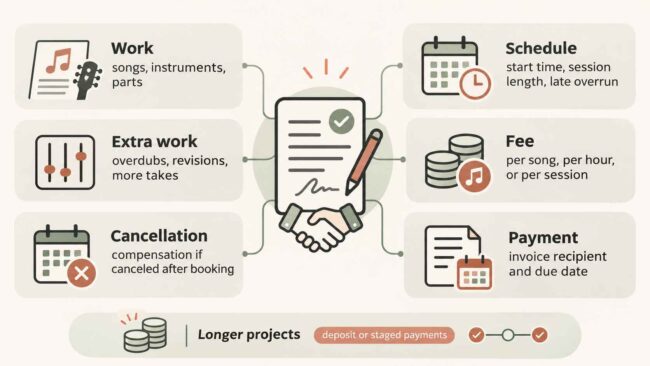
The cancellation question is easy to overlook. If you reserve Friday for one producer, you may turn down another job. A cancellation the evening before leaves little opportunity to replace the income.
For longer projects, consider requesting a deposit or agreeing on payments at different stages. Put the terms in writing before work begins.
Know What Happens to Your Performance After Recording
Imagine recording a bass part for an independent artist. Six months later, the song appears in a television advertisement.
Did the original session fee include commercial advertising use? Were additional payments agreed upon? Did you sign a consent form covering that use?
The answers depend on the contract and the applicable rules.
The Musicians’ Union explains that session musicians may receive additional fees when recordings are used in ways not covered by the original agreement. Certain collective agreements contain specific provisions for further use.
There is also an important difference between performing on a recording and helping write the song.
Playing a guitar part written by the producer does not automatically give you a share of the songwriting royalties. If you contribute original music to the composition, discuss songwriting credits and the percentage split with the other writers.
Get those terms settled before the track is released. Trying to establish who wrote what several months later is considerably harder.
Make Invoicing a Routine, Not a Monthly Emergency

Musicians can spend an entire afternoon perfecting a recording and then forget to send the invoice.
Send yours promptly after completing the agreed work. Include your name or business details, the client, invoice number, recording dates, services performed, total fee, due date and payment instructions.
Keep a separate record of outstanding invoices. A simple spreadsheet is enough when you are starting out.
For each booking, track the amount invoiced, the payment deadline and the date the money actually arrives. An unpaid invoice should never be counted as cash available for next month’s expenses.
If the payment date passes, send a short reminder quoting the invoice number and agreed deadline. Consistent administration prevents awkward conversations from turning into avoidable financial problems.
Build Relationships With the People Who Book Musicians
A great performance might impress an audience. A great session performance needs to impress the producer, artist or musical director responsible for booking the next job.
Reliability has considerable value in recording work. Producers need musicians who arrive prepared, respond to direction and deliver clean recordings without repeated reminders.
For remote sessions, make the files easy to use. Agree on sample rate, file format, tempo references and the required delivery method. Export tracks with clear names and a common starting point so the producer can import them into the project without manually aligning every file.
A reliable setup matters, too. Choosing the right digital audio workstation can make recording, editing and delivering tracks more efficient.
A portfolio should demonstrate the actual work you want to be hired for. Three short examples showing your ability to play different styles will generally tell a producer more than a long biography full of vague claims.
Use recordings you have permission to share. Unreleased client material should remain private unless the client agrees otherwise.
After a successful session, staying in contact is reasonable. A short message mentioning your availability for future recording work is enough. There is no need to send weekly reminders to someone who has not requested them.
Keep track of the clients who repeatedly book you. Find out which projects provide the most dependable income and which require the most unpaid preparation.
Do Not Fill Every Empty Date With Cheap Work

A $100 session might look attractive when your calendar is empty. But if it requires a long drive, expensive parking and several hours of preparation, the actual return can be disappointing.
Low-paying work is not always a mistake. A first session with a respected producer may introduce you to people who book musicians throughout the year. Recording for an emerging artist might also lead to a valuable working relationship.
Still, potential future opportunities are uncertain. Consider the actual fee, time required and project terms before accepting work on the assumption that it will eventually lead to something bigger.
You also need days for practicing, arranging, maintaining equipment and contacting clients. Filling the calendar with poorly paid work leaves little room to pursue better bookings.
When Is It Safe to Leave Your Other Job?
A run of successful sessions can make full-time music work feel financially secure. Three or four strong weeks, however, provide little information about what happens during a quiet season.
Before leaving salaried work, examine at least six months of paid bookings. Calculate your average earnings, business costs and the percentage of income that comes from repeat clients.
Pay attention to concentration risk. If one producer accounts for most of your earnings, losing that relationship could create an immediate problem.
A more stable position is having several independent clients, repeat bookings and enough savings to cover a period without work.
You might also keep teaching, arranging or performing live as additional income sources. Those activities can support a recording career when studio demand slows.
The most useful test is to build a calendar of confirmed work, compare it with the money already received and calculate how long your savings would last if new bookings stopped. Make the decision using those figures rather than the excitement of a particularly successful recording month.