
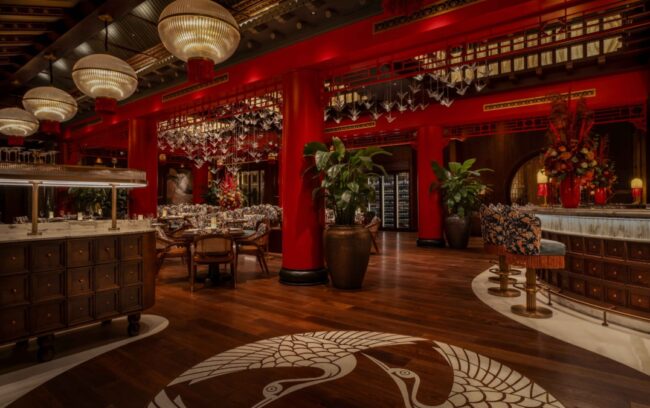
Some rooms are simply cameras’ favorites. Point a lens anywhere in a great Chinese dining room and the frame fills itself: lantern light, lacquer gloss, a red that somehow flatters everyone standing near it. Film crews know it, music video directors know it, and every influencer with a dumpling order knows it too.
None of it is luck. The scene-stealing details are specific, nameable, and ranked below, and anyone who wants the full blueprint behind them should read a proper Chinese restaurant interior design guide, because the tradition has been perfecting this list for centuries. Count them down with us.
Details Ten and Nine – The Threshold and the Red
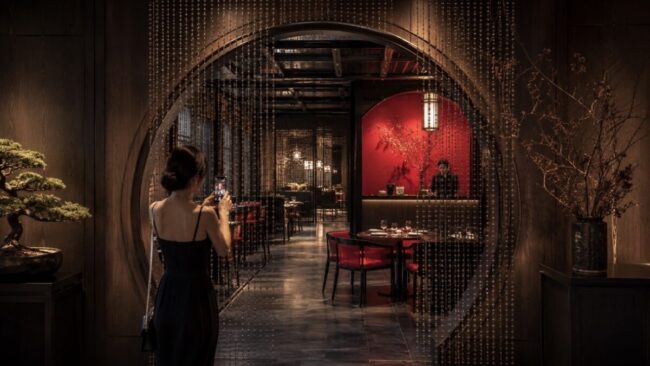
Great rooms begin before the room. Detail ten is the entrance itself: a moon gate, a carved doorway, a curtain of beads or silk. The transition frame is cinema’s oldest trick, and Chinese design has always built it in. A threshold turns a picture into a story about entering one.
Phones come out at the doorway before anyone has seen a menu. Watch the sequence repeat all evening: a pause under the carved beam, one photo, then the step inside. The entrance earns its ranking because it meets every guest first and photographs well from six feet away.
Detail nine is red, deployed like a chorus rather than a flood: a wall behind the host stand, seat upholstery, the interior of an alcove. In Chinese tradition the color carries luck and celebration, and on camera it carries the whole composition. One saturated red element against dark wood is the most reliable frame in the building.
Eight and Seven – Screens, Shadows, and the Turning Table
Detail eight, fretwork, is famous for two reasons. In frame, the geometric screens produce pattern and depth. Out of frame, they cast patterned shadows over tables and faces, and cinematographers will shift furniture around to catch them. Rooms with carved partitions ship with their own lighting effects.
Detail seven is the turning center of the large round table, pure theater: dishes wheeling by like a carousel of alternatives, hands reaching, the group moving around a shared axis. Video loves it especially. It is that rare piece of furniture that makes its own action sequence.
There is a reason wedding videographers and food vloggers fight for the seat opposite the lazy Susan. The rotation gives a static table motion, and motion is what keeps a clip alive past the third second. A slow spin, a reaching hand, and the edit cuts itself.
Six and Five – Lanterns and Lacquer
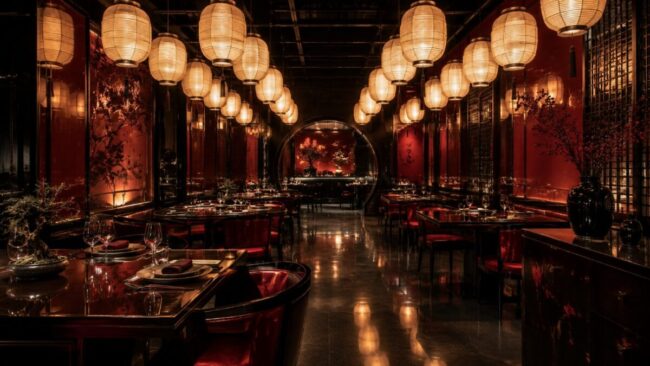
The classic paper lantern, detail six, hangs in rows and solves what photographers struggle with most: warm, diffuse, repeating light sources that make every face look candlelit. A run of lanterns down a dining room is both illumination and composition, rhythm overhead in every wide shot.
Detail five is lacquer. Dark glossed surfaces, tabletops, chair frames, wall panels, act as the room’s mirrors, doubling every light source laid near them. Highlights float inside black-red surfaces and the whole frame reads expensive. Matte rooms photograph flat; lacquer rooms photograph cinematic, and the difference is one finish decision.
That shine pays a practical bonus in daily use too. Lacquered and high-gloss finishes on contract furniture shrug off spills and wipe clean between seatings, so the surface that doubles the light also survives the service.
Four and Three – The Hero Wall and the Tea Close-Up
Every photo is anchored by significance and motion in detail four, a single wall of brushwork. Characters moving vertically. One enormous scroll. Even those who can’t read it can feel the gesture in the strokes. This is what art directors call the hero wall, and rooms without one force every shot to develop its own subject.
Detail three belongs to the tea service. Mini porcelain cups, a steaming pot, hands mid-pour over dark wood: the most dependable close-up in food photography, built-in. It works because it is ritual and not prop styling, and cameras can smell the difference.
Restaurants that keep the full set, tray, pot, strainer, and tiny cups, hand guests a photo kit with every order. The steam does the work of a lighting rig. Nobody styles it, nobody stages it, and that is exactly why the shot lands every time.
Two – Round Tables, Full Frames
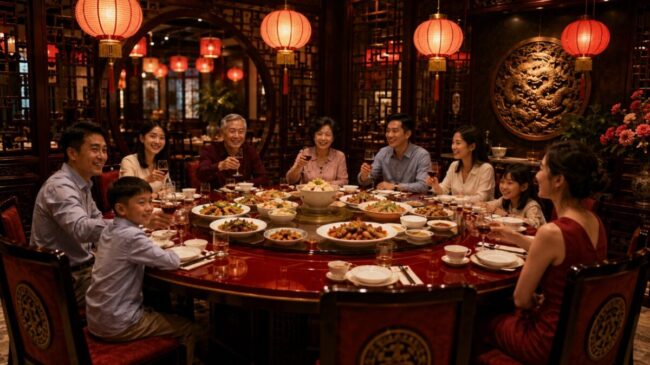
The big round eight-top might be the single most photogenic furniture format in hospitality, and it earns the number-two spot on volume alone.
- Everyone faces the lens somewhere in the arc.
- Food forms a still life at the table’s center.
- No one’s back ever blocks the shot.
Commercial-grade rounds with proper bases keep the tableau steady while the toasts and the turntable spin above. Directors of family scenes reach for this table the way composers reach for a chorus.
Size matters here in a very literal way. A full 72-inch round seats ten guests without crowding elbows, and a wider circle deepens the still life at its center.
One – The Glow From the Street
And the winner: the exterior shot at night, red and amber light pouring through windows and doorway onto the pavement. Every food show opens with it; every city montage includes it. The room’s whole interior conspires to produce that spill of light, and it markets the restaurant to every passerby with a camera, which is now every passerby.
Signage completes the effect after dark. Gold characters over a red ground, backlit or washed from below, turn the facade into a marquee, and the sidewalk into front-row seating. Some owners spend thousands on ads; the best ones let the window glow run the campaign.
Roll Credits on the Room
Ten details, one conclusion: the tradition builds rooms that perform. Light sources multiplied and softened, color placed like punctuation, furniture that stages people generously, ritual that hands every camera a subject. Scene-stealing, it turns out, is a design specification.
For owners, the takeaway is happily practical: build the details and the cameras work for you, nightly, for free. Start with the lighting and the round table, the two highest-scoring items per dollar, and let the hero wall wait for the second renovation. The feed will find the room either way. For the rest of us, the takeaway is simpler still. Next dumpling night, look up from the plate for one minute, then check your own camera roll on the way home. The room has been posing this whole time, and it photographed better than the food. Lights, lanterns, action: the room was always the co-star, billed just below the dumplings. The encore, as ever, belongs to the lanterns.