
Gates of Olympus by Pragmatic Play throws players into the world of Greek gods, where Zeus hands out random multipliers and cascading wins. Many fans in India download the Linebet app to try it on their phone before betting real money. Since its release in 2021, the game has become one of the most recognizable titles in online slots, largely because it strips away the traditional reel-and-payline format and replaces it with something faster, louder, and more visually chaotic.
Understanding why it works the way it does – and why “winning” in a random-number-generator game is really about managing expectations rather than chasing a system – makes the experience far more enjoyable.
The Mythology Behind the Reels

Long before it was a slot machine, Mount Olympus was the mythical home of the twelve major Greek gods, ruled by Zeus, god of the sky and thunder. Ancient Greek storytellers used Olympus as a stage for tales about power, fate, and fortune – themes that translate surprisingly well into a modern gambling product.
Pragmatic Play leaned into this imagery deliberately: the golden columns, the thunderclouds, and the flying coins are all meant to evoke the idea of divine favor raining down on mortals below. It’s a familiar visual shorthand that game studios have used for decades, from ancient Egypt-themed slots to Norse mythology titles, because players instinctively associate gods and treasure with big, unpredictable rewards.
What Gates of Olympus Actually Is
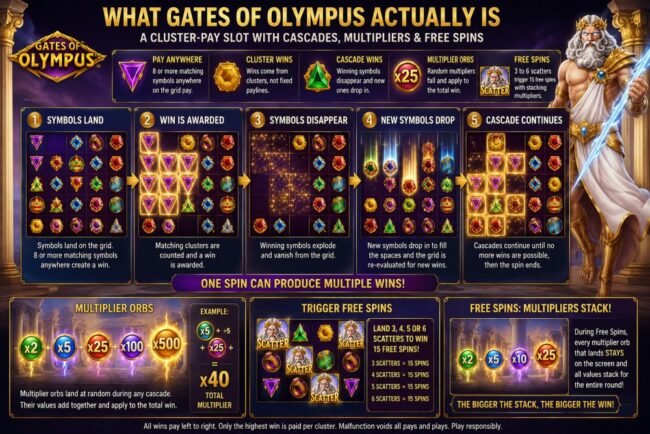
The Gates of Olympus slot runs on a Pay Anywhere engine, so wins come from clusters rather than fixed paylines. Land 8 or more matching symbols anywhere on the grid and the payout lands, no lines required.
This is a meaningful departure from classic three-reel or five-reel slots, where a win depends on specific symbols lining up across a payline running left to right. Cluster-pay mechanics instead reward players for the sheer quantity of matching symbols on screen, regardless of their position, which tends to produce more frequent – though often smaller – wins interspersed with occasional larger ones.
Winning symbols then disappear and new ones drop in, creating cascade wins from a single spin. This cascading (sometimes called “tumbling reels”) mechanic means a single spin can technically produce multiple consecutive wins as the grid refills and re-evaluates itself, similar to how blocks disappear and new ones fall in a match-style puzzle game. Each cascade continues until no further matches are found, at which point the round ends and a new spin begins.
Multiplier orbs from x2 up to x500 can fall at random and apply to the total bet. These orbs are the game’s signature feature and the reason it built such a strong following – a multiplier orb landing during a cascade adds its value to a running total, and if multiple orbs appear in the same sequence, their values are summed before being applied to any win that follows.
The free spins round starts when 3 to 6 scatters appear, giving 15 rounds where multipliers stack together. During free spins, every multiplier orb that lands stays on screen and accumulates for the remainder of the round, which is why the bonus round is where the game’s biggest payouts theoretically become possible.
Why the Math Matters More Than the Myth

It helps to understand a few technical terms before spinning any cluster-pay slot, since these figures explain the shape of the experience far better than any story about gods and thunderbolts.
RTP (Return to Player) is a theoretical percentage, calculated over millions of simulated spins, describing how much of all wagered money is expected to be returned to players over the long run. It says nothing about what will happen in any single session – a 96% RTP does not mean a player gets back 96 paise of every rupee in an afternoon, only that the mathematical average converges there over an enormous sample size.
Volatility (sometimes called variance) describes how wins are distributed. A low-volatility game pays small amounts frequently. A high-volatility game, which is what Gates of Olympus is generally classified as, pays out less often but can produce disproportionately large wins when it does. This is why sessions on the game can feel like long stretches of quiet punctuated by sudden bursts of activity — that pattern is a mathematical property of the game, not a sign that it is “due” for a win or that a losing streak is about to end.
Hit frequency refers to how often any winning cluster appears at all, separate from how big that win is. High-volatility, high-hit-frequency games can still feel active even while the average win size stays modest most of the time.
None of these numbers can predict a single spin. Every result comes from a random number generator, so no spin can be predicted and no win is ever guaranteed. Bankroll control matters far more than any system.
Game Versions and the Demo Mode
The demo runs on virtual credits, so a person can test every feature without risking a rupee. It behaves like the real game in mechanics, only the money is fake, which makes it perfect for learning the pace before completing a login process at an online casino to play the slot. Trying the free version first is a useful habit for any new slot, not just this one, because it lets a player see how quickly a balance moves up and down without any financial consequence.
Beyond the original, there are spin-offs worth knowing:
- Super Scatter – an alternate version that drops scatter symbols more often, changing the pacing of how frequently the free spins round triggers.
- The 1000 edition – built around a larger top multiplier, aimed at players who want to see how high the ceiling can theoretically go.
- The Ante Bet option – raising the stake by 25% to double the free spins chance, a trade-off that increases the cost per spin in exchange for a higher probability of reaching the bonus round.
The RTP sits around 96%, and the demo is the easiest way to feel how each version pays. Comparing the standard version against Super Scatter or the 1000 edition in demo mode is a good way to understand how each variant actually feels in practice, since the paytable numbers alone don’t fully capture how frequently bonus features trigger.
Practical Tips for New Players
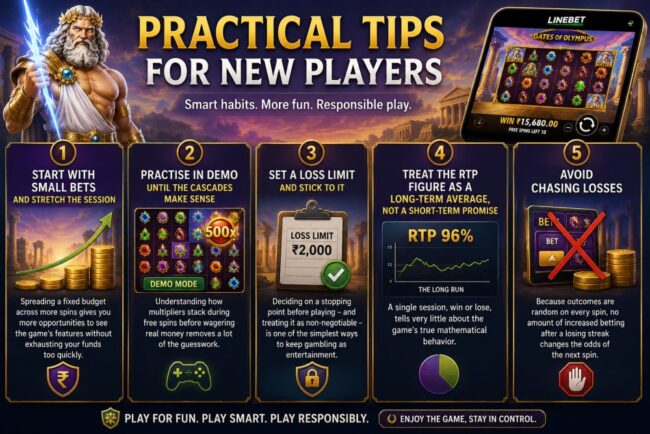
Because volatility runs high, wins can arrive in bursts and then go quiet. Trying Gates of Olympus on the Linebet mobile app keeps the whole thing casual, which is exactly how responsible play should feel. A few habits tend to make the experience more enjoyable and less financially risky:
- Start with small bets and stretch the session. Spreading a fixed budget across more spins gives more opportunities to see the game’s features without exhausting funds in the first few minutes.
- Practise in the demo until the cascades make sense. Understanding how multipliers stack during free spins before wagering real money removes a lot of the guesswork.
- Set a loss limit and stick to it. Deciding on a stopping point before playing – and treating it as non-negotiable – is one of the simplest ways to keep gambling as entertainment rather than a financial strategy.
- Treat the RTP figure as a long-term average, not a short-term promise. A single session, win or lose, tells very little about the game’s true mathematical behavior.
- Avoid chasing losses. Because outcomes are generated randomly on every spin, no amount of increased betting after a losing streak changes the odds of the next spin.
The Bigger Picture
Slots like Gates of Olympus succeed commercially because they combine simple, understandable rules with visually dramatic moments – a multiplier orb landing feels exciting regardless of the underlying probability. That excitement is part of the entertainment product being sold, and it’s worth remembering that the game is designed, tested, and mathematically balanced by the studio to be profitable over the long run for the operator, just as any casino game is.
Enjoying it as a form of entertainment, with firm limits in place, is a very different activity from treating it as a way to make money. Anyone who feels that gambling is becoming difficult to control, or that sessions are affecting their finances, wellbeing, or relationships, should consider reaching out to a local gambling support service or helpline for confidential advice.