
There is a moment in every game development project that nobody talks about. It happens around frame thirty of a walking cycle, or character number twelve in an RPG cast, or the third time you try to match the color palette from a sprite you drew six months ago. The moment when you realize that your game no longer looks like one game. It looks like several games, stitched together by a developer who was trying their best but could not hold the visual thread. This is not a failure of skill. It is a failure of process. And it is the single biggest reason why indie games with great mechanics often feel amateurish in their presentation.
The Invisible Enemy: Style Drift and Its Causes
Style drift is the gradual, almost imperceptible change in visual consistency across a body of work. It happens because humans are not machines. When you draw frame one of an animation, your hand is fresh, your eye is calibrated, and your color mixing is precise. By frame thirty, you are tired. Your hand moves differently. The color you mixed no longer matches the color you mixed at the start. The line weight has shifted. The proportions have drifted. Professional studios solve this with exhaustive style guides, reference sheets, and layers of quality control. Indie developers solve it by hoping nobody notices.
The problem compounds across characters. The sprite you drew for your protagonist six months ago does not quite match the sprite you drew for the shopkeeper last week. The walking animation you created at the start of development does not share the same visual DNA as the attack animation you created yesterday. The result is a game that feels visually incoherent, even if each individual sprite is well-executed. This is the hidden cost of manual sprite creation. It is not just the time. It is the slow erosion of visual unity.
The Platform’s Approach: Style as a Locked System
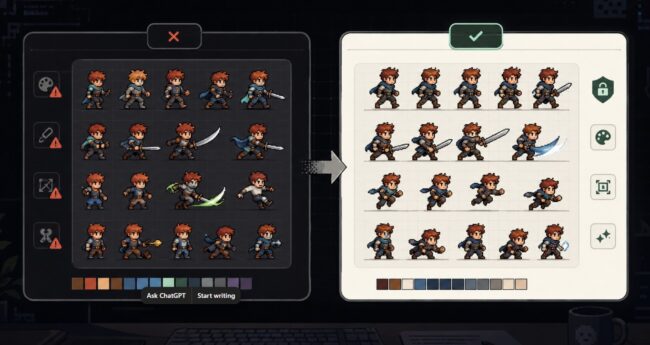
The platform addresses this problem not through better tools for manual correction, but through a fundamental rethinking of how style is managed. Instead of expecting the artist to maintain consistency across hundreds of frames, it extracts the style once and locks it. AI Sprite Generator asks for three to five reference images of your desired art style. From these, the AI extracts your color palette, line thickness, detail level, and proportional rules. Every sprite generated thereafter uses only your approved colors and follows those locked parameters. Frame one and frame one hundred look identical in style. Your walking animation at the start of development matches your attack animations created six months later.
This is not a minor convenience. It is a structural solution to a structural problem. The platform does not ask you to be more consistent. It makes consistency the default state.
Testing the Consistency Claim: A Six-Month Simulation
To test whether the platform actually delivers on its consistency promise, I ran an experiment that simulated a real development timeline. I generated a character sprite set at the beginning of the experiment, then generated additional characters and animations at intervals over several weeks, deliberately changing the reference images and inputs to see if the locked style would hold.
The Baseline: Establishing the Style Lock
I started with a pixel art character in a sixteen-bit style. I uploaded five reference images: a front view, a side view, a back view, and two action poses. The style lock trained in under three minutes. The extracted parameters included a specific color palette of twenty-four colors, a line thickness of two pixels, a detail density that matched the reference, and proportional rules for the character’s anatomy.
The First Test: Generating the Full Animation Set
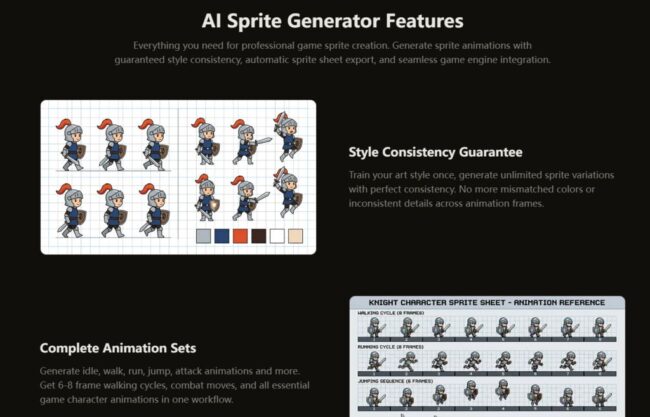
From this locked style, I generated the complete animation set: idle, walk, run, jump, attack, hit reaction, and death. Each animation used the same locked parameters. The walking cycle had the same line weight as the attack animation. The idle loop used the same colors as the death sequence. The consistency was immediate and obvious. There was no drift because there was no manual intervention. The system produced every frame using the same rules.
The Second Test: Adding New Characters Months Later
Two weeks later, I generated a second character—a different class, different equipment, different pose—using the same locked style. The new character shared the same color palette, the same line thickness, the same detail level. It looked like it belonged in the same game world as the first character. The proportional rules ensured that the new character had the same height-to-width ratio, the same head-to-body proportion, the same visual weight. One developer using the platform reported generating forty-seven unique character sprites in a single weekend with perfect style consistency. This is not an accident. It is the result of a system that treats style as a locked resource rather than a constantly shifting target.
The Third Test: Character Variations Without Redrawing
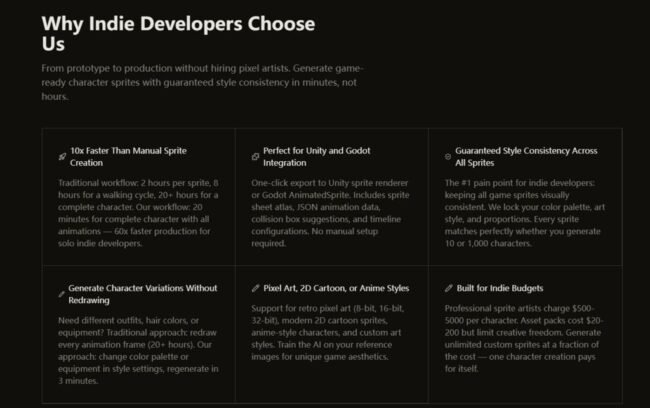
The third test explored what happens when you need variations of the same character. Traditional workflows require redrawing every animation frame for every variation—a process that can exceed twenty hours per variation. The platform regenerates variations in about three minutes by changing only the color palette or equipment settings. I generated armor tier variations, outfit variations, and weapon variations for the same character. Every variation shared the same base proportions and the same locked style parameters. The result was a set of characters that were visually distinct but unmistakably part of the same family. One mobile game developer created thirty character variations in two hours. The style consistency across all thirty variations was perfect.
The Practical Workflow: Where Consistency Matters Most
The platform’s consistency features are not equally valuable in every scenario. Understanding where they deliver the most impact helps you integrate the tool effectively into your development pipeline.
RPGs and Strategy Games: The Cast of Characters
For games with large casts of characters, consistency is not optional. It is the difference between a cohesive world and a collection of random sprites. The platform’s ability to generate eight-directional sprites for top-down and isometric views is particularly valuable for RPGs and strategy games. One character base generates all eight angles automatically. Every angle shares the same locked style. Every character in the cast shares the same locked style. The result is a game world that feels unified, even when populated by dozens of unique characters.
Mobile and Casual Games: The Variation Engine
For mobile and casual games that rely on character variations—different outfits, colors, equipment tiers—the platform’s consistency features are essential. Players notice when a character’s color palette shifts between screens. They notice when the line weight changes between animations. The platform eliminates these issues by locking the style once and generating all variations from that locked state. The result is a game that feels polished, even when the art is generated rather than hand-crafted.
Pixel Art: The Special Case
Pixel art presents a unique challenge for consistency because the constraints are so tight. A single pixel out of place can break the illusion. The platform supports retro pixel art at 8-bit, 16-bit, and 32-bit resolutions. The color palette locking is essential for pixel art consistency—one developer noted that color palette locking is essential for pixel art consistency. The platform’s ability to maintain exact color values and precise pixel placement across hundreds of frames is something that would be nearly impossible to achieve manually without exhaustive reference checking.
The Limitations: Where Consistency Is Not Enough
Consistency is valuable, but it is not the only measure of quality. The platform’s animations, while consistent, can feel procedural. They are correct but not inspired. For hero characters, narrative moments, or emotionally charged scenes, the consistency of the platform’s output may not compensate for its lack of expressive nuance. One developer using the platform noted that they use Aseprite for hero characters and the platform for everything else. This hybrid workflow acknowledges that consistency is a baseline requirement, not the ultimate goal.
The platform also requires quality inputs to produce quality outputs. Uploading five rough sketches will produce five rough sketches worth of consistency. The style lock is only as good as the reference images you provide. If your references are inconsistent, the locked style will be inconsistent. The platform does not fix bad art. It fixes inconsistent art.
The Verdict: Consistency as a Service
The platform does something that no manual workflow can match. It guarantees style consistency across every sprite, every animation, every character, every variation, and every session. This is not a feature. It is a fundamental rethinking of how game art is produced. Traditional workflows treat consistency as a goal to be achieved through effort and discipline. The platform treats consistency as a default state that requires no effort to maintain.
For indie developers, this is transformative. It means you can build a game with dozens of characters and hundreds of animations without worrying about visual drift. It means you can generate new characters months after your initial development without breaking the visual unity of your game. It means you can focus on gameplay, story, and mechanics while the platform handles the tedious work of maintaining visual consistency.
The platform does not replace the need for artistic judgment. You still need to decide what looks good, what fits your game’s tone, and what needs refinement. But you no longer need to spend hours checking whether frame thirty matches frame one. The platform handles that for you. AI Sprite Generator makes consistency the easy part of game development. For a growing number of indie developers, that is exactly the shift they have been waiting for.