
Ask ten people why their animated photo came out warped, and most will blame the model. Watch what they typed, though, and a different culprit appears: the instruction itself asked for the impossible.
A still image is a single frozen instant with no second frame to reason from, and the words you hand it decide whether the invented motion feels natural or tears the picture apart.
Treating those words as a kind of grammar, with rules about what a photograph can and cannot be told to do, changed my results more than switching engines ever did.
Working through an ai video maker that exposes several models at once made those rules visible, because the same phrase behaves differently depending on which engine reads it.
The platform I used was Viddo AI, and what follows is not a feature tour but an attempt to describe that grammar plainly: which motion words a photo tends to obey, which ones it fights, and why.
Why a Frozen Frame Resists Being Set Moving

A video model animating a photograph is guessing at frames that never existed. It knows one instant and must invent what came before and after, which means every word of motion is really an instruction about how much to invent.
Ask for a little, and the guesswork stays close to the original. Ask for a lot, and the model has to fabricate detail it has no basis for, which is where faces slip and lines bend.
Understanding motion prompts as invention budgets, rather than commands, is the whole foundation of writing them well.
Camera Verbs and Subject Verbs Behave Differently
The single most useful distinction I found is between moving the camera and moving the thing in front of it. They are not interchangeable, and they carry very different risk.
Moving the Camera Through a Still Scene
Camera language asks the model to shift the viewpoint while leaving the subject essentially intact.
Camera Motion Stays Safer Than Invented Action
In my testing, slow pushes, gentle rises, and small drifts were the most dependable instructions across engines, because the subject barely changes and only the framing moves.
It appears the model has less to fabricate, so identity and geometry survive. Forward motion held up more reliably than wide lateral sweeps, which sometimes bent edges near the frame.
Asking the Subject Itself to Move
Subject language asks the person, object, or scene to change, which demands far more invention.
Subject Motion Raises the Risk of Distortion
From a practical user perspective, small subject motion was manageable, a slight smile, a subtle shift, while large gestures or turns were where features started to wander.
The lesson was not to avoid subject motion, but to keep it modest and let the camera carry the rest.
The Rule of One Motion Per Prompt
Beyond the camera-versus-subject split, the second rule is about quantity, and it is the one most people break first.
Stacking Movements Dissolves Into Visual Noise
Ambitious prompts tend to pile motions together: pan while the subject turns while the light shifts. Each addition multiplies the invention the model must reconcile.
One Clear Instruction Outperforms Several Competing Ones
Prompts built around a single dominant motion produced cleaner, more legible clips than layered ones.
When results wobbled, thinning the prompt to one clear move fixed more problems than adding descriptive detail ever did. Results may still vary between runs, so a couple of attempts per idea remained normal.
The Path From Still Photo to Moving Clip
The production loop stays short, which matters when refining motion words is an iterative craft rather than a one-shot task.
Selecting Image-to-Video and a Fitting Engine
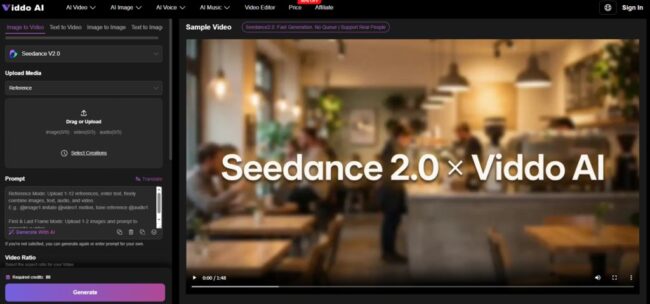
You begin by choosing the image-to-video task and one of the models shown together in the workspace.
Different Engines Read Motion Words Their Own Way
Because Viddo AI sends prompts straight to each model without conversion, the same motion phrase can land differently across engines, so a quick comparison on one photo reveals which reads your intent best.
Uploading the Image and Describing the Move
Next you upload the still and describe the motion, leaning on the keyword helper when the phrasing is unclear.
Restrained Wording Protects the Original Subject
Modest, specific motion language consistently preserved the subject better than ambitious action, which invited the model to invent too much.
Setting Format and Generating the Clip
Finally you set aspect ratio, resolution, and duration, then generate and review the result.
Regenerating With Adjusted Motion Words
When a clip drifts, changing the motion words and running again is quick, which is exactly how the grammar gets learned.
Which Motion Instructions Hold and Which Break
The table summarizes the reliability patterns that emerged, in plain terms.
| Motion Instruction | Typical Reliability | Best Used For |
| Slow camera push-in | High | Portraits, products, openers |
| Gentle rise or drift | High | Scenes, interiors, ambience |
| Small subject gesture | Moderate | Faces, subtle life in a still |
| Large subject action | Low | Rarely worth the distortion risk |
| Several stacked motions | Low | Avoid in a single prompt |
Where Motion Grammar Reaches Its Real Limits
No amount of careful phrasing overrides the underlying constraints. The source image sets a hard ceiling, since a soft or cluttered photo does not sharpen by gaining motion.
Complex scenes may need several regenerations before one holds, and identical prompts can differ run to run, so consistency is never assured.
Faces pushed toward big movement remain the likeliest thing to warp regardless of wording.
Fine on-screen text stays unreliable, and free-plan output on Viddo AI carries a watermark, so polished clips require a paid plan. Grammar improves the odds; it does not repeal them.
Who Should Learn to Write Motion Well
The people who gain most are those who animate stills regularly enough for the craft to compound: creators repurposing photo archives, marketers turning product shots into short loops, and anyone who would rather steer a result than gamble on one.
Learning which motions a photograph will obey turns a frustrating slot machine into something closer to a predictable tool.
Occasional users chasing a single clip may be happy letting the helper guess for them. But for anyone building a repeatable practice around turning still images into motion, the words are the instrument, and they reward being learned.