
Systematic review screening often becomes more complicated than the protocol suggests. A researcher may have the candidate paper open in one tab, the screening platform in another, a bibliographic database somewhere else, and several searches running for references that need a closer look.
None of those tasks is unusual on its own. The problem appears when checking one citation repeatedly pulls attention away from the paper being assessed. A questionable reference may sit inside a methods paragraph that affects how the study is understood, yet verifying it can mean leaving the page, searching by title or author, comparing publication details, and then returning to the original claim.
A better workflow keeps verification close to the document while preserving the review protocol as the basis for inclusion and exclusion decisions.
Why Citation Checks Work Better Beside the Paper
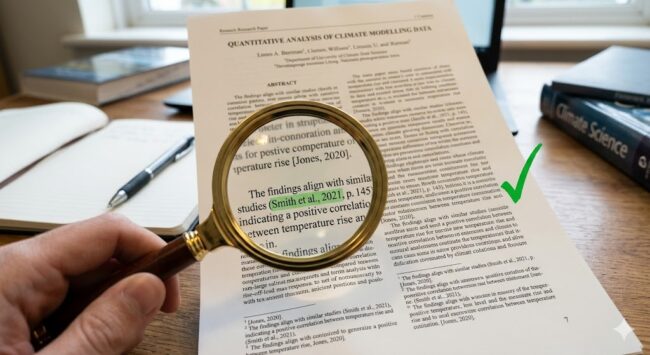
Full-text screening depends on context. Researchers are not simply deciding whether a reference exists. They are reading the study as a whole and determining whether it satisfies predefined eligibility criteria covering factors such as population, intervention, comparator, outcomes, and study design.
That makes unnecessary switching between tools especially inconvenient. A browser-based verification option can shorten the distance between spotting a questionable citation and checking it. CiteTrue’s Citation Checker, for example, allows citations to be checked from a browser side panel while the current page remains open, which can be useful when a researcher wants to verify a reference without abandoning the paper being screened.
The important point is where verification fits into the process. It supports screening by identifying references that deserve attention. It does not determine whether a study belongs in the review.
Screening Decisions Still Start With the Protocol
Systematic review methods depend on eligibility criteria established before individual studies are judged.
Cochrane describes predefined, unambiguous eligibility criteria as a fundamental requirement of a systematic review. Those criteria should guide which studies enter the review rather than concerns that arise informally during screening.
That distinction matters when a suspicious reference appears.
Suppose a paper cites an earlier trial to justify its outcome measure, but the year is wrong or the publication cannot immediately be located. That deserves investigation, particularly if the citation affects interpretation of the methods. It does not automatically create a new reason for exclusion.
A verification problem may eventually reveal information relevant to eligibility or quality assessment. Until then, it is a flag that needs resolution.
Check the References That Could Change the Assessment
There is rarely a good reason to verify every citation in every paper during screening.
A typical article may contain dozens of references covering background information, definitions, previous findings, methodological decisions, and supporting evidence. Treating all of them equally turns screening into bibliography auditing and quickly consumes time that should be spent assessing eligibility.
The more useful approach is selective.
References deserve closer attention when they support a claim that matters to the interpretation of the study. That could include:
- a previous trial used to justify the intervention or comparator;
- a validation study for an important measurement instrument;
- a guideline used to define treatment or diagnostic procedures;
- a methodological source that explains an unusual analytical decision;
- a publication that appears to represent an earlier report of the same study.
The question is not simply, “Can this citation be found?” It is, “Would a problem with this citation affect how this paper should be assessed?”
That keeps verification proportional to its role in the review.
Start With the Basic Bibliographic Details
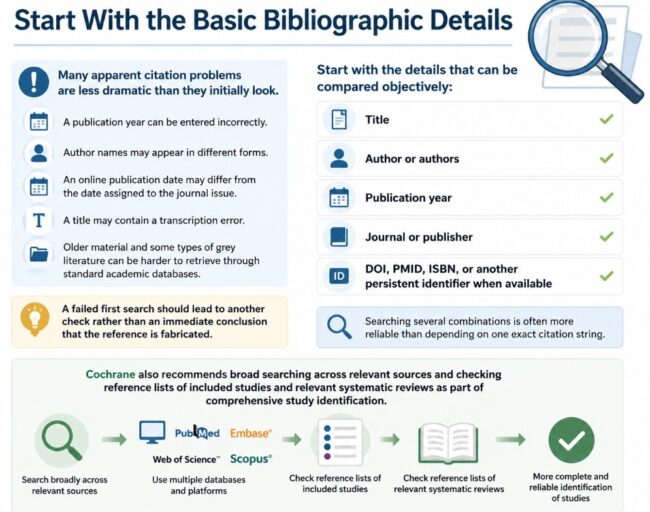
Many apparent citation problems are less dramatic than they initially look.
A publication year can be entered incorrectly. Author names may appear in different forms. An online publication date may differ from the date assigned to the journal issue. A title may contain a transcription error, while older material and some types of grey literature can be harder to retrieve through standard academic databases.
For that reason, a failed first search should lead to another check rather than an immediate conclusion that the reference is fabricated.
Start with the details that can be compared objectively:
- Title
- Author or authors
- Publication year
- Journal or publisher
- DOI, PMID, ISBN, or another persistent identifier when available
Searching several combinations is often more reliable than depending on one exact citation string.
Cochrane also recommends broad searching across relevant sources and checking reference lists of included studies and relevant systematic reviews as part of comprehensive study identification.
A Missing Reference Is a Flag, Not an Exclusion Rule
One of the easiest mistakes in citation verification is treating “not found” as equivalent to “does not exist.”
Those are not the same conclusion.
The reference may contain incorrect metadata. The work may be indexed under another title. It may appear in a database that was not searched. Conference material, reports, theses, books, and older publications can also require different retrieval methods from mainstream journal articles.
The sensible response is to document the problem and investigate in proportion to its importance.
If the citation only supports general background information, the issue may have little effect on screening. If it underpins a crucial part of the study design, a more extensive search makes sense.
The result of that investigation can then be considered alongside the review protocol and any later appraisal of study reliability.
Keep Verification Separate From Risk-of-Bias Assessment

Citation problems can raise legitimate questions about a paper, but they should not be confused with formal risk-of-bias assessment.
Risk-of-bias tools examine specific features of study design, conduct, analysis, and reporting. Whether one supporting reference contains a wrong year or cannot immediately be located is a different issue.
Similarly, discovering a questionable citation does not establish research misconduct.
There are situations in which publication status does become directly relevant. Cochrane advises reviewers to examine relevant corrections, retraction notices, expressions of concern, and other information that may affect the reliability of studies considered for inclusion. The guidance specifically notes that errata can expose important limitations and that publications may have been corrected or retracted since they first appeared.
That is much stronger evidence than an unsuccessful citation search and should be handled accordingly.
Record the Problem Before Moving to the Next Paper
Citation verification loses much of its value when researchers investigate a problem but fail to record what they found.
A short note is usually enough.
Instead of writing “reference suspicious,” record the actual issue:
- cited year differs from the matched publication;
- title and authors match, but journal details differ;
- DOI resolves to a different article;
- publication not located after searches by title, author, and identifier;
- correction or retraction notice found;
- possible match identified but still requires reviewer confirmation.
Specific notes make disagreements easier to resolve later because another reviewer can see what triggered the concern.
They also reduce repeated work. Without a written record, the same reference may be investigated again during consensus meetings, data extraction, or quality assessment.
Keep Eligibility Decisions Traceable

Systematic reviews need a clear record of how studies moved from search results to final inclusion.
PRISMA 2020 recommends reporting the number of records identified, screened, excluded, retrieved for detailed evaluation, and ultimately included. For reports that appear eligible but are excluded after closer assessment, the guidance calls for reasons for exclusion to be provided.
Citation verification can provide useful information during that process, but it should not produce vague new categories such as “bad references” unless those categories were part of a defensible review method.
A study should be excluded because it fails an applicable eligibility criterion, not because a tool displayed a warning.
If investigation of a reference reveals that the paper uses an ineligible study design, describes a different population, duplicates another report, or has been retracted in a way that affects its reliability, the underlying finding is what matters.
Use a Simple Verification Routine
A consistent routine makes citation checking less disruptive during large screening batches.
| Stage | Action | Goal |
| Read | Assess the paper against eligibility criteria | Keep the protocol central |
| Identify | Flag citations tied to important claims | Avoid checking decorative references |
| Verify | Compare bibliographic details and source records | Establish what can actually be confirmed |
| Record | Write the specific discrepancy | Preserve context for another reviewer |
| Escalate | Search further when the reference materially matters | Spend time where uncertainty affects assessment |
| Decide | Apply the review protocol | Keep verification and eligibility separate |
The process does not need to be elaborate. Its value comes from consistency.
Researchers should know which references deserve checking, what counts as an unresolved issue, how concerns are documented, and when another reviewer needs to examine them.
Do Not Turn Screening Into a Reference Audit
Systematic reviews already involve substantial work: searching, deduplication, title and abstract screening, full-text assessment, data extraction, risk-of-bias evaluation, synthesis, and reporting.
Citation verification should make that process more reliable, not create another review inside the review.
The most efficient approach is to investigate references when there is a clear reason to do so. Keep the paper visible, verify the citation while its relevance is still clear, record any meaningful discrepancy, and continue screening.
A questionable reference can reveal a simple metadata error, a publication that requires a broader search, a corrected article, or a more serious problem that deserves escalation. What matters is distinguishing those situations rather than treating every failed match as the same finding.
Keeping citation checks close to the paper helps preserve that context. The verification tool handles the lookup. The researcher still decides what the result means within the review methodology.